Most Ethiopia guides spend three paragraphs on “ancient empires” and “dramatic landscapes” before telling you anything useful. This one skips that part.
Here’s what actually matters before you book: visas, safety, money, climate, and the logistics nobody mentions until you’re already on the ground. We wrote this from years of running trips here it’s what we get asked in real emails, not what sounds good in a brochure.
Ethiopia at a Glance
| Capital | Addis Ababa (pop. approx. 5 million) |
| Population | Around 130 million |
| Official language | Amharic, alongside Oromiffa, Tigrinya, and 80+ other languages |
| Currency | Ethiopian Birr (ETB) |
| Time zone | GMT+3, year-round — no daylight saving |
| Calendar | Ethiopian calendar, 13 months, roughly 7–8 years behind the Gregorian calendar |
| Electricity | 220V, 50Hz, European-style two-pin plugs |
| Main airport | Bole International Airport, Addis Ababa |
Geography: Know What You’re Dealing With
Ethiopia borders Eritrea, Djibouti, Somalia, Kenya, South Sudan, and Sudan. It’s about 1.1 million km², roughly twice the size of Texas.
The elevation range is the thing to plan around. The Simien Mountains hit some of the highest peaks in Africa. The Danakil Depression drops to one of the lowest, hottest points on Earth. In between: highland plateau, Rift Valley lakes, savannah, forest.
That range is exactly why packing “for Africa” as one generic climate doesn’t work here. More on that below.
UNESCO World Heritage Centre – Ethiopia’s nine listed sites
History: Older Than You Think
The 3.2-million-year-old remains of “Lucy” were found in the Afar region in 1974. An older find, Ardipithecus ramidus at 4.4 million years, turned up in the same region in 1994. That’s part of why Ethiopia gets called the cradle of humankind it’s not just a tourism slogan.
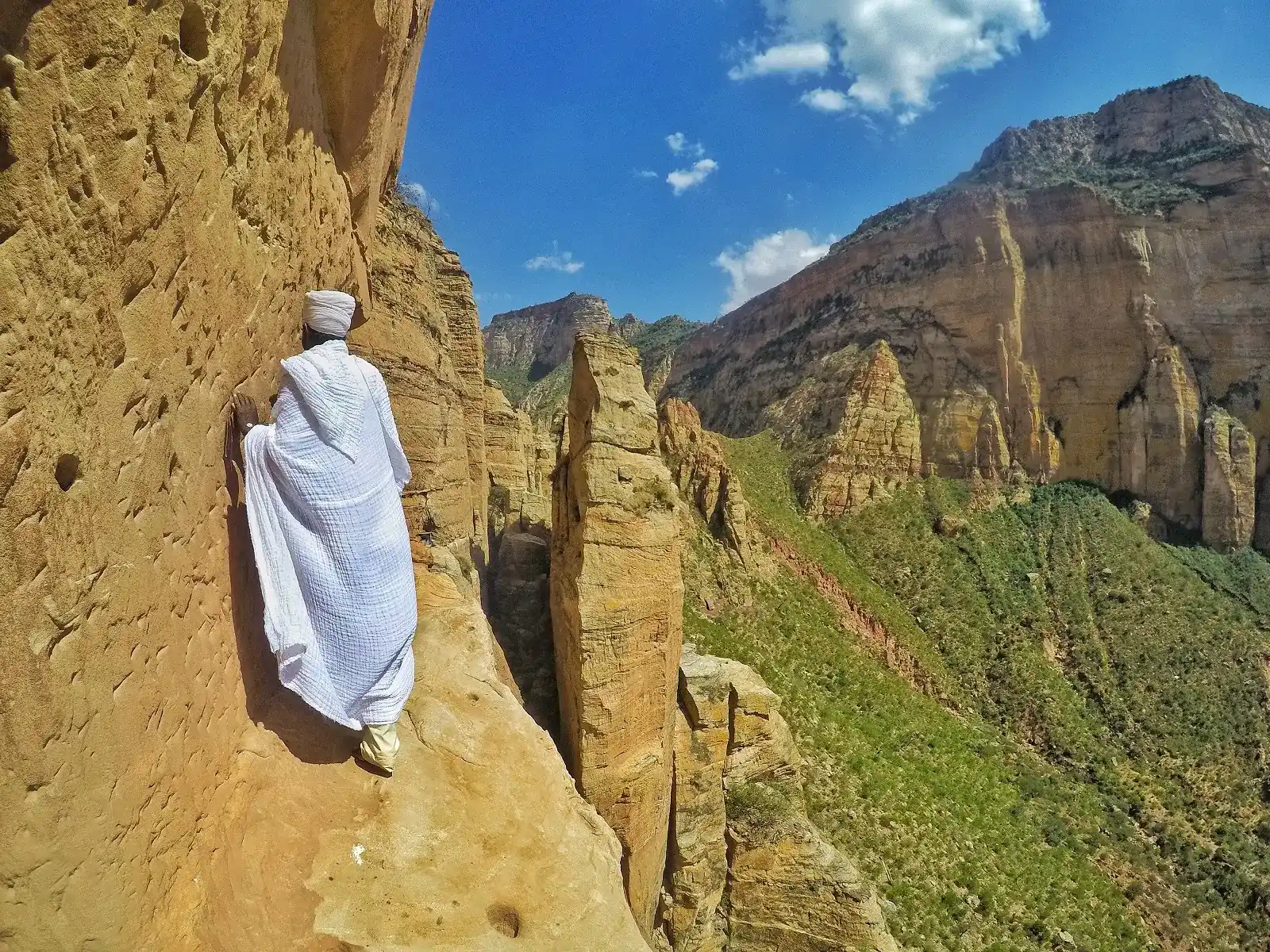
From there the record barely breaks: the stelae and royal tombs of Axum, cliff churches like Abuna Yemata Guh, the 13th-century rock-hewn churches at Lalibela, and the walled city of Harar, home to more than 80 mosques.
One more fact worth knowing before you land: Ethiopia was never colonized. Italy occupied the country from 1936 to 1941 that’s the extent of it. No lasting colonial rule, no colonial-era culture layered on top. That’s rare on this continent, and it’s a big part of why Ethiopian culture reads as distinct rather than imported.
People and religion: Over 80 ethnic groups, roughly as many languages. Religiously: about 44% Ethiopian Orthodox Christian, 31% Muslim, 19% Protestant or Evangelical, the rest traditional or other faiths. Hospitality holds steady across all of it; you’ll notice it within a day.
Climate & When to Go
Two seasons: dry (roughly November–May) and wet (June–October). February to May are the driest.
Most of the historic route sits at altitude, so daytime highs in the highlands rarely pass 30°C even at the hottest point in the year. Nights get cold, pack layers – this isn’t the tropical Africa most people picture before they arrive.
The southern Rift Valley is milder. The eastern lowlands and Danakil are hot and dry. The far southwest is hot and humid.
If Danakil Depression is on your list, go October through February. Peak dry season there isn’t just warm – it’s genuinely hard on the body.
Check the video below and discover more places to visit in Ethiopia.
Visas: Check Before You Book Flights
Most nationalities need a visa. Most apply through Ethiopia’s e-visa system in advance. A handful of nationalities get visa-on-arrival.
Rules change. Don’t rely on a blog post including this one, eventually – for the exact current requirements. Confirm directly on Ethiopia’s official e-visa portal before you book anything.
Ethiopia’s official e-visa portal
Health & Safety
Vaccines: A Yellow Fever certificate is required for entry. Carry it even if nobody checks. Hepatitis A/B, typhoid, tetanus, and polio are commonly recommended. Talk to a travel clinic based on your actual itinerary.
Malaria: The historic-route highlands (Axum, Gondar, Bahir Dar, Lalibela) and the area just south of Addis are largely malaria-free. Lower elevations aren’t. Check a current malaria-risk map before you go, don’t assume based on this page alone.
Crime: Addis Ababa is one of the safer capitals in the region. Normal city rules apply; watch your bag in crowded places like Mercato, don’t flash cash, stay alert around sudden “distractions” in the street that’s usually the setup for a pickpocket.
Regional safety: We won’t sugarcoat this part. Conditions vary a lot by region in Ethiopia and can shift with little warning. Check your own government’s travel advisory for the specific regions on your route before you book, and again right before you fly. Any operator worth using will raise this with you, not bury it in fine print.
Sun and stomach: Highland sun is stronger than it feels. Bring real sunscreen, not the travel-size tube you’ll forget to reapply. Anti-diarrhea tablets treat symptoms, not causes. If it’s more than a mild stomach upset, see a doctor. Government hospitals are accessible along most tourist routes.
Money
The currency is the Ethiopian Birr (ETB). The exchange rate is set periodically through a government auction, so check a current rate close to your travel dates, don’t work off a number you saw six months ago.
There’s no fixed limit on foreign currency you can bring in, but you have to declare it on arrival and exchange it at a bank or authorized dealer. Keep the declaration form. You need it again on departure.
ATMs work fine in Addis and major towns. Carry cash for smaller towns and rural stops. Don’t assume a card works everywhere, because it won’t.
Getting Around
Air: The fastest way to cover distance. Addis to Axum is about two hours by air versus multiple days by road. Ethiopian Airlines runs the domestic network.
Road: Better scenery, worse math. Distances that look short on a map take longer than they should because of road conditions. A private driver who actually knows the route is worth the cost; this is where a lot of independent trips lose entire days.
Rail: The old Addis-Djibouti line has a rough history of underinvestment and partial fixes. It’s not a realistic option for tourism right now, whatever the history books say about it.
Most trips mix flights between hub towns with private road transfers for sightseeing. That’s how our tour packages are built, not because it sounds nice, but because it’s the efficient way to actually do it.
Where to Stay and Eat
Addis Ababa has everything from international five-star chains to solid budget guesthouses. Along the historic route and in remote areas like Omo Valley, standards drop and rooms are limited. So you need to book ahead.
In places like Danakil or Omo Valley, camping isn’t a downgrade, it’s the setup. Expect a real tent, a sleeping mattress, and a crew handling the logistics, not a bag and a hope.
Addis Ababa’s food scene is more varied than most people expect. Italian, Indian, Armenian, Lebanese, and Chinese restaurants alongside Ethiopian food. Get a coffee ceremony in. Coffee’s origin story starts here, literally.
What to Pack
Layers. That’s the one rule that actually matters.
- Real sunscreen and a hat
- A light rain layer if you’re traveling June–September
- Broken-in walking shoes, you’ll be on uneven church steps and trekking paths
- Basic first aid: antiseptic cream, anti-diarrhea tablets
- A universal adapter (220V, European-style plugs)
A full packing list by region and season is coming. This short version covers most of it.
Combine It With Neighboring Countries
You’ll need a separate visa for each country, but road and air links make combination trips workable. Common add-ons:
- Eritrea: Asmara’s Italian-era architecture, Red Sea coast
- Djibouti: Lac Abbé’s salt flats
- South Sudan: cultural safaris out of Juba
- Somaliland: an underexplored corner of the Horn
Ask about an extension when you start planning your trip, we build it into the same itinerary instead of treating it as a separate booking.
Frequently Asked Questions
Is Ethiopia safe for tourists?
Addis Ababa and the main tourist routes are generally safe, with normal city precautions advised. Conditions vary by region and can change so, check your government’s current travel advisory before booking and again before departure.
Do I need a visa to visit Ethiopia?
Most nationalities do, usually through Ethiopia’s e-visa system in advance. A small number of nationalities get visa-on-arrival. Requirements change, so confirm before booking flights.
What’s the best time of year to visit?
Roughly October through April, with January and May the driest. For Danakil specifically, go October through February – the peak dry season where temprature drops to it’s lowest annual record.
What currency should I bring?
US dollars are the easiest to exchange for Birr. Bring cash – ATMs are reliable in cities but not in remote areas and declare it on arrival.
Do I need vaccinations for Ethiopia?
A Yellow Fever certificate is required. Hepatitis A/B, typhoid, tetanus, and polio are commonly recommended, depending on your itinerary and health history.
Next Step
That’s the guide. No padding, no “imagine a place where ancient empires meet dramatic landscapes.”
If you want this turned into an actual itinerary, get our free consultation where replies usually come back in minutes, not days.