12 Days North and South Ethiopia Tour
Explore Ethiopia’s 12-day adventure through Erta Ale, Dallol, Gheralta churches, Axum, Lalibela, and Omo Valley tribes. Discover history, culture, and unforgettable landscapes..
Itinerary Details
Before dawn breaks over the Ethiopian Highlands, pilgrims draped in white cotton shawls begin their descent. They file down narrow stone staircases cut into the earth, ducking through passageways carved from solid rock, and emerge into vast churches lit by beeswax candles and filled with the low chant of liturgy that has echoed here for more than eight centuries. This is Lalibela, a place where the ground itself has been transformed into sacred architecture.
Perched at roughly 2,500 meters in the Amhara region of northern Ethiopia, the Lalibela churches are among the most extraordinary feats of human craftsmanship ever created. These Ethiopian rock churches stand as the finest example of their kind anywhere on the continent. Eleven medieval churches, each carved top-down from a single mass of volcanic rock, form a complex that UNESCO inscribed as a World Heritage Site in 1978. More than 200,000 Ethiopian Orthodox Christian pilgrims visit annually for major religious festivals, and the number of international travelers discovering this site grows every year.
Yet Lalibela remains remarkably uncrowded compared to the world’s other monumental sites. While Machu Picchu and Angkor Wat manage visitor caps in the millions, Lalibela offers something those sites cannot: these are not ruins. Every one of the eleven churches is an active place of worship where priests conduct daily services, guard ancient manuscripts, and carry forward oral traditions passed down through generations.
This guide covers everything you need to know about how to visit Lalibela, the history and legends behind their construction, a detailed look at all eleven churches, the architectural ingenuity that made them possible, and a practical visitor section covering entrance fees, travel logistics, etiquette, and the best time to visit Lalibela.
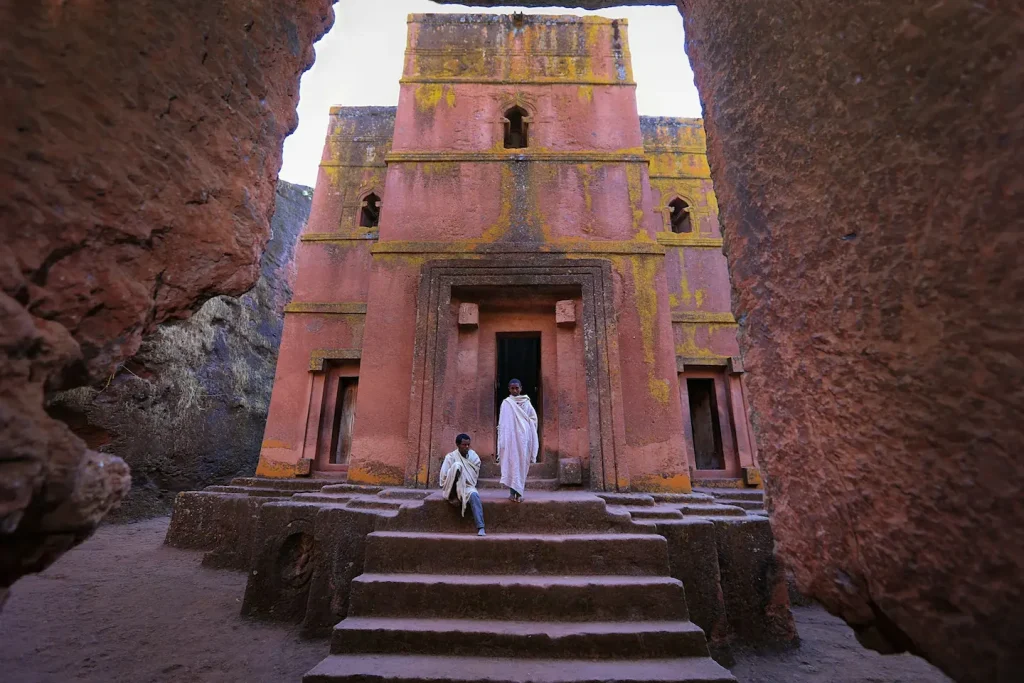
The Lalibela rock-hewn churches are a cluster of eleven monolithic and semi-monolithic churches located in the town of Lalibela in Ethiopia’s northern highlands. Unlike conventional buildings raised from the ground up with blocks or bricks, these churches were created through a subtractive process workers carved downward from the surface, chiseling trenches into the volcanic basalt to isolate massive blocks of stone, then hollowing out the interiors to create rooms, pillars, arches, windows, and doorways. Everything you see, from the floor to the ceiling to the columns, is a single continuous piece of rock.
The churches are organized into three groups. Five churches sit north of the town’s ceremonial river (named the Jordan, after the biblical river). Five more stand to the south and east. And one Biete Giorgis, the Church of Saint George stands alone in its own deep courtyard, connected to the others by a system of underground tunnels and trenches.
Together, they earned UNESCO World Heritage status in 1978 under three cultural criteria recognizing their masterful craftsmanship, their influence on church architecture across Ethiopia, and their exceptional testimony to medieval Ethiopian civilization. The inscription committee called them “a remarkable example of a traditional African architectural form.”
The most widely told origin story centers on King Gebre Meskel Lalibela, who ruled Ethiopia’s Zagwe Dynasty from approximately 1181 to 1221 AD. According to Ethiopian tradition, the young prince was poisoned by a rival and, while in a death-like slumber, was transported to heaven. There, God instructed him to return to earth and build a New Jerusalem, a holy city where Ethiopian Christians could make pilgrimage without the perilous journey to the real Jerusalem, which had fallen to Saladin’s forces in 1187.
The legend holds that King Lalibela oversaw the carving of all eleven churches in just 24 years, with angels continuing the work at night while human laborers rested.
Whether one takes the legend literally or not, the historical record confirms that King Lalibela was the driving force behind the site’s creation. He renamed geographic features around the town to mirror the Holy Land: the local river became the Jordan, and individual churches were assigned names echoing sacred sites in Jerusalem Golgotha, Bethlehem, the Tomb of Adam.
Modern archaeological scholarship complicates the single-generation narrative. Research published by the Metropolitan Museum of Art and other institutions suggests the churches were likely constructed over a much longer period, possibly spanning from the 7th to the 13th century. Some structures, particularly in the southern group, may have originally served as secular or royal buildings before being consecrated as churches.
The architectural evidence supports this. Several churches deliberately imitate the design vocabulary of the Aksumite Empire, which had fallen centuries before the Zagwe Dynasty took power. Art historians argue this was a calculated political choice: by reviving the visual language of the great Aksumite builders, the Zagwe kings sought to legitimize their own authority and link themselves to Ethiopia’s most prestigious imperial tradition.
This scholarly counter-narrative does not diminish Lalibela’s achievement. If anything, it expands it suggesting that the site represents not one king’s vision but a continuous, multigenerational effort to carve a sacred landscape from the earth.
The name “New Jerusalem” is not a marketing label. It is a working spiritual geography. The town’s river is the Jordan. The hill behind the northern churches is Mount Tabor. Biete Golgotha contains a replica of the Tomb of Christ. Biete Lehem takes its name directly from Bethlehem. For Ethiopian Orthodox Christians, a pilgrimage to Lalibela carries genuine theological weight, this is their Holy Land.
The most important pilgrimage periods are Timkat (Ethiopian Epiphany, celebrated in January with processions and baptismal reenactments), Genna (Ethiopian Christmas, January 7), and Meskel (the Finding of the True Cross, in late September). During Timkat, more than 200,000 pilgrims converge on the churches, creating scenes of extraordinary devotion that have changed little over eight centuries.
The churches divide into three groups, each reachable on foot. Underground tunnels and narrow trenches connect many of the structures, and a single entrance ticket covers all eleven.
The northern cluster sits on higher ground and includes several of the site’s most architecturally ambitious churches.
Biete Medhane Alem (House of the Saviour of the World) is the largest monolithic church in the world. It measures roughly 33 by 23 meters and stands surrounded by 72 external pillars though erosion has toppled several over the centuries. Its design is thought to be modeled on the original Church of Saint Mary of Zion in Aksum, the holiest site in Ethiopian Christianity. Inside, the space is vast and column-lined, more cathedral than chapel.
Biete Maryam (House of Mary) may be the oldest church at the site. Its interior is the most richly decorated of all eleven, with carved crosses, geometric patterns, and a distinctive Star of David window motif. A tunnel connects it directly to Biete Medhane Alem. Tradition holds that this was the first church King Lalibela completed.
Biete Golgotha Mikael (House of Golgotha and Saint Michael) is actually two churches joined together. Golgotha is believed to house King Lalibela’s own tomb and contains life-sized carved reliefs of saints on its walls, a rarity among Ethiopian churches. The Golgotha section is restricted to male visitors, one of the few gender-specific restrictions at the site.
Biete Meskel (House of the Cross) is a small, intimate chapel notable for its cross-shaped relief carvings on the interior walls. It functions as an antechamber or companion to the larger adjacent churches.
Biete Denagel (House of Virgins) is dedicated to the nuns and female martyrs of early Christianity. It is the most deteriorated of the northern group, with portions of its structure partially collapsed, but it remains consecrated and in use.
The southern cluster sits lower, across the Jordan river, and includes some of the most architecturally distinctive structures.
Biete Amanuel (House of Emmanuel) is widely regarded as the finest example of Aksumite architectural style at Lalibela. Its exterior features alternating protruding and recessed horizontal layers that perfectly imitate the wood-and-stone construction technique of ancient Aksumite buildings except here, the entire structure is a single piece of rock. Some scholars believe it may originally have served as a royal palace before its conversion to a church.
Biete Qeddus Mercoreus (House of Saint Mercurios) is one of the more enigmatic churches, with evidence suggesting it may have once been used as a secular structure possibly a court or even a prison. Its interior houses notable 15th-century paintings and religious art that are among the site’s most important surviving artworks.
Biete Abba Libanos (House of Abbot Libanos) is a “semi-monolith” unlike the fully freestanding churches, its roof remains physically attached to the cliff above. Legend credits its construction to King Lalibela’s wife, Kebre Meskel, who is said to have overseen its carving as a personal act of devotion.
Biete Lehem (House of Holy Bread) takes its name from the biblical Bethlehem and is one of the smallest churches, generally inaccessible to casual visitors.
Biete Gabriel-Rufael (House of the Archangels Gabriel and Raphael) offers one of the most dramatic approaches of any church at the site. Visitors cross a narrow wooden walkway spanning a deep trench to reach the facade. Its monumental entrance and imposing walls have led some researchers to suggest it, too, may have originally functioned as a royal residence.
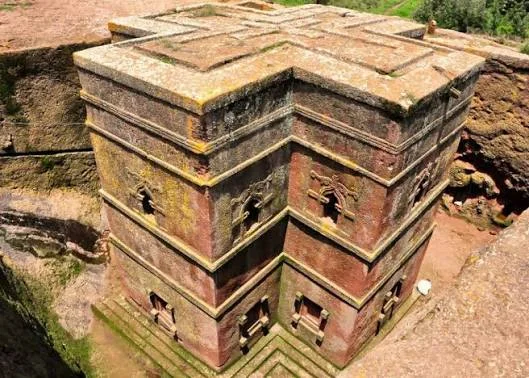
No visit to Lalibela is complete without Biete Giorgis, the Church of Saint George, and no photograph captures the site better than the aerial view of this church carved in the shape of a perfect Greek cross.
Biete Giorgis sits in its own courtyard, isolated from both the northern and southern groups. The courtyard measures roughly 72 by 72 feet and drops 36 feet below ground level. The church itself descends 12 meters into the earth, its three-tiered roof flush with the surrounding ground. Greek crosses are carved into the top of each tier.
Legend has it that after King Lalibela completed the other ten churches, Saint George appeared to him on horseback and reproached him for not dedicating a church to him. The king promised to build the most magnificent of all and Bet Giyorgis, with its architectural perfection, is the result.
Archaeologists date this church to the late 12th or early 13th century, making it among the last structures completed at the site. Its geometric precision and pristine preservation make it the most visited and most photographed of all the Lalibela rock-hewn churches.
The construction method behind the rock churches of Lalibela remains one of the ancient world’s most impressive engineering achievements. Unlike Petra’s famous Treasury, which is a facade carved into a cliff face with natural rock left behind it, Lalibela’s churches are fully three-dimensional structures excavated from the earth in every direction roof, walls, floor, interior columns, windows, and doorways, all isolated from the surrounding bedrock.
The process began at the top. Workers first cut wide trenches into the volcanic basalt to define the church’s outer boundaries, creating a freestanding block of stone still attached to the ground at its base. They then carved the exterior details, windows, doors, decorative moldings, and the layered horizontal bands that imitate Aksumite architecture. Only after the exterior was finished did they hollow out the interior, chiseling rooms, corridors, pillars, and arches from within.
The tools were simple: hand-held hammers and chisels. No evidence of mortar, scaffolding, or mechanical equipment has been found. The stone itself scoriaceous basalt, a vesicular volcanic rock was relatively soft when freshly exposed to air, making it easier to carve, then hardening over time as it dried. This geological property was almost certainly understood and exploited by the builders.
Four of the eleven churches are fully freestanding monoliths, entirely separated from the mountain. Seven are semi-monolithic, sharing one or more walls with the surrounding cliff. All of them incorporate hydraulic engineering features, including drainage channels, gutters, and water collection basins designed to divert Ethiopia’s heavy seasonal rains away from the structures, a practical concern that remains critical to their survival today.
The comparison to the world’s other great carved structures illuminates what makes these Ethiopian rock churches unique. Petra is carved into cliff faces. Cappadocia’s cave churches in Turkey are hollowed from soft volcanic tuff. India’s Ellora Caves combine carving and construction. But Lalibela’s churches are carved downward from the surface, freestanding in excavated courtyards, with fully finished exteriors and interiors, a construction philosophy that exists almost nowhere else on Earth.
It is important to emphasize what sets Lalibela apart from nearly every other ancient monument on the world tourism circuit: these churches are not museums. They are not ruins. They are not archaeological sites preserved behind ropes and glass.
Every one of the eleven Lalibela rock-hewn churches is an active house of worship maintained by the Ethiopian Orthodox Tewahedo Church. Priests conduct daily services before dawn, their chanting echoing through the stone chambers. Deacons carry processional crosses and swing censers of incense through the narrow tunnels. The faithful come to pray, to confess, to celebrate communion — just as their ancestors have done since the 12th century.
The churches also serve as repositories of sacred objects. Ancient manuscripts written on goatskin parchment in Ge’ez, the liturgical language of the Ethiopian church, are stored in their interiors. Ornate processional crosses made of brass and wood, some dating back centuries are brought out during festivals. Religious paintings and icons adorn the walls.
For the Lalibela pilgrimage during Timkat in January, the atmosphere transforms entirely. More than 200,000 Orthodox Christians arrive from across Ethiopia, many having walked for days. The churches overflow. Night services under open skies, illuminated by candles and the highland stars, create a scene that visitors consistently describe as one of the most profound spiritual experiences of their lives.
This is the living heart of the site, and it is what no photograph or guidebook can fully convey. Among all the Lalibela churches in Ethiopia, it is this spiritual continuity not the stone that visitors remember most. Lalibela is not a monument to the past. It is a place where the past has never stopped.
By air is the most practical option. Ethiopian Airlines operates daily flights from Addis Ababa to Lalibela, with a flight time of roughly 1 to 1.5 hours. This is the route most international visitors take. Some itineraries combine Lalibela with flights to Gondar, Bahir Dar, or Axum on Ethiopia’s northern historical circuit.
By road, Lalibela is reachable from Addis Ababa in roughly two days of driving, or as a day connection from Gondar or Bahir Dar. The roads are scenic but rough in places, and the overland option is best suited for travelers with flexible schedules and an appetite for adventure. Lalibela’s airport sits approximately 25 kilometers from the town center; transfers are easily arranged.
The current entrance fee for foreign visitors is approximately $50 USD, which covers access to all eleven churches and is valid for five consecutive days. Payment is made at the ticket office in town; paying in Ethiopian Birr typically yields a better exchange rate than paying in dollars.
A practical tip: purchase your ticket the afternoon before your first visit. This avoids the morning queue at the office and lets you head straight to the churches at dawn, when the light and atmosphere are at their finest. A separate entrance fee of approximately $20 USD applies to the Asheton Maryam Monastery above the town. Ethiopian nationals pay a reduced fee.
Official licensed guides are available at the ticket office for approximately $20–30 USD per day. Hiring one is not mandatory, but it is strongly recommended. The site is a labyrinth of tunnels, courtyards, and passageways that can be disorienting without someone who knows the layout. More importantly, a good guide provides the historical, religious, and architectural context that transforms the visit from sightseeing into genuine understanding.
Be cautious of unlicensed freelance guides who approach arriving travelers at the airport or in town. Stick with licensed guides registered at the official ticket office.
The dry season from October through March offers the best weather, clear skies, comfortable temperatures, and ideal conditions for photography. This is the most popular period for international visitors.
For an unforgettable cultural experience, time your visit around Timkat (January) or Genna (January 7), when the Lalibela pilgrimage reaches its peak. The atmosphere during these festivals is unlike anything else in travel. Be aware, however, that the churches and town will be crowded, and accommodation books up months in advance.
The rainy season from June through September brings fewer tourists and lower prices, but stone walkways can be slippery, and some paths between churches may be muddy. The Meskel festival at the end of September marks the transition to dry season and offers a less-crowded alternative to January’s festivals.
Regardless of season, arrive at the churches by 6 AM for the most atmospheric experience. Morning light fills the courtyards, services are often underway, and other visitors are few.
Lalibela’s churches are active religious sites, and respectful behavior is expected.
Shoes must be removed before entering every church. Bring socks, as the rock floors can be cold in the morning and hot by midday. Cover your shoulders and knees regardless of gender. Women should carry a headscarf, as hair covering is required or expected in several churches. Photography is generally permitted inside the churches without flash, but always ask permission before photographing priests, worshippers, or sacred objects. Remain quiet during services, and avoid pointing the soles of your feet toward religious items or altar areas.
At minimum, plan for two full days: one for the northern group and Bet Giyorgis, one for the southern group. This pace allows you to spend time inside each church without rushing.
The ideal visit is three days, which adds time for the trek to Asheton Maryam Monastery (a one-hour uphill hike with panoramic views of the surrounding highlands), a day trip to the Yemrehanna Kristos cave church (42 kilometers from town, older than the rock-hewn churches themselves), and the chance to return to favorite churches at golden hour for photography and quieter reflection.
Lalibela rewards visitors who stay beyond the churches.
Asheton Maryam Monastery sits above the town on a mountain ridge, reached by a one-hour uphill trek. The monastery itself is carved into a cave and houses ancient religious manuscripts. The real reward, though, is the panoramic view of the Lasta Mountains and the town of Lalibela spread out below.
Yemrehanna Kristos is a 12th-century church built inside a natural cave, located about 42 kilometers from Lalibela. It predates the rock-hewn churches and represents a different architectural tradition rather than carving from rock, this church was constructed from alternating layers of wood and stone in the classic Aksumite style, then sheltered within the cave. Few visitors make the trip, which is part of its appeal.
Local markets operate on Tuesdays and Saturdays, offering spices, handwoven textiles, traditional baskets, and other crafts. The markets are a window into daily life in the Ethiopian highlands and a welcome contrast to the solemnity of the churches.
Ethiopia’s coffee ceremony is an essential cultural experience. Ethiopia is the birthplace of coffee, and the traditional ceremony of roasting green beans over charcoal, grinding by hand, brewing in a clay jebena pot is practiced in homes and roadside stalls across Lalibela. The process takes about 30 minutes and typically involves three rounds of progressively lighter coffee.
Ben Abeba restaurant, perched on a hillside above town, is worth visiting as much for its surreal Scottish-Ethiopian architecture (designed by a Scottish woman who settled in Lalibela) as for its food. The views at sunset over the highlands are spectacular.
There are ancient monuments, and then there are ancient monuments that refuse to become ancient. Lalibela is the second kind. Eight hundred years after King Lalibela’s workers laid down their chisels, priests still chant before dawn in the same stone chambers. Pilgrims still descend the same carved stairways. Incense still rises through the same windows cut from volcanic rock.
The Lalibela rock-hewn churches are often compared to Petra, to Angkor Wat, to the great carved temples of India. The comparison is fair in scale and ambition, but it misses what makes Lalibela different. Those sites are preserved. Lalibela is alive. And it remains, for now, one of the world’s most extraordinary places that relatively few international travelers have seen, a window that will not stay this uncrowded forever.
Whether you come to explore the Lalibela churches in Ethiopia for their history, their architecture, their spiritual atmosphere, or simply to stand in a courtyard cut 36 feet into the earth and look up at a cross carved from the roof of the world, Lalibela delivers something no other place on Earth can replicate.
Explore Ethiopia’s 12-day adventure through Erta Ale, Dallol, Gheralta churches, Axum, Lalibela, and Omo Valley tribes. Discover history, culture, and unforgettable landscapes..
Itinerary DetailsExplore Ethiopia’s wildest terrains in 9 days – Danakil’s heat, Lalibela’s rock churches, Simien Mountain’s peaks. Fully guided, all logistics included..
Itinerary Details
Discover one of Africa's greatest living wonders on a fully guided 3 days Lalibela tour with Worldsun Ethiopia Tours. Carved directly into volcanic rock….
Itinerary DetailsDiscover the wild frontier of the Danakil Depression, a blistering, brutal landscape where volcanoes, acid springs, shimmering salt flats and fiery geological fury collide..
Learn More
Meet the beating heart of Africa in Addis Ababa – home to the African Union, scores of foreign embassies and a pulse you’ll feel….
Learn More
A crown-jewel of Ethiopia and a UNESCO World Heritage Site, Simien Mountains offers some of the world’s finest trek-routes, unique wildlife..
Learn More
Free itinerary consultation – no obligation, typically a reply within 3 minutes.