1 Day Tigray Churches Tour
Spend one extraordinary day exploring ancient cliff-carved churches in the Tigray region of Ethiopia, including the dramatic Abuna Yemata Guh..
Itinerary Details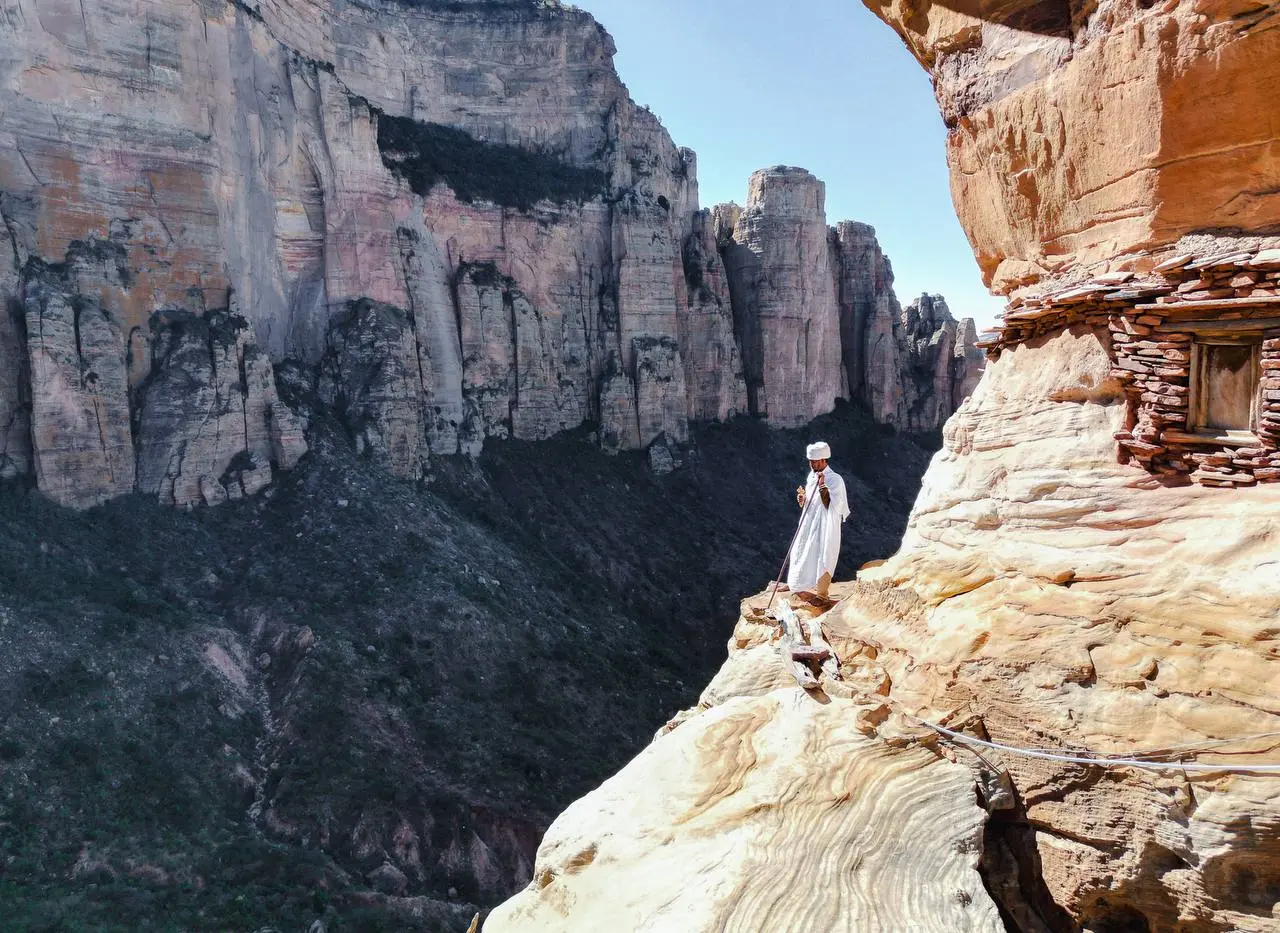
Every morning, in the thin air above Ethiopia’s northern highlands, a priest removes his shoes and begins climbing. His route takes him across a sandstone ledge barely wider than his foot, past a drop of two hundred metres, and into a church carved directly into the face of a cliff. He has made this climb thousands of times. His father made it before him. The frescoes waiting inside, painted sometime around the 5th or 6th century – are older than most European cathedrals.
This is the world of the Tigray rock churches, and there is nothing else quite like it on Earth.
While Ethiopia’s subterranean churches at Lalibela draw most of the international attention, the rock-hewn churches of Tigray represent something arguably more extraordinary: more than 120 sanctuaries carved into vertical cliff walls, mountain caves, and sandstone pinnacles across the rugged highlands of northern Ethiopia. Together, they form what is believed to be the single largest concentration of rock-hewn architecture anywhere in the world.
Read More about sacred landscapes of Tigray.
Many of these churches date from the 4th to 15th centuries. Most remain active places of worship within the Ethiopian Orthodox Tewahedo Church. And several can only be reached by climbs that would make a mountaineer pause.
This guide covers their history, the key churches worth knowing, the art preserved inside them, their path toward UNESCO recognition, the devastating impact of the 2020–2022 Tigray conflict on this heritage, and practical information for planning a future visit.
The story of the Tigray rock churches begins with the Aksumite Empire, one of the great civilisations of the ancient world. Around 330 AD, the twin emperors Abreha and Atsbeha – known historically as Ezana and Saizana – adopted Christianity, making the Kingdom of Aksum one of the earliest states to embrace the faith.
According to tradition, the conversion was guided by Frumentius, a Syrian-Greek who became Ethiopia’s first bishop. His influence was so profound that his prayer cross is still preserved inside the church of Abreha We Atsbeha in Tigray – a tangible thread connecting the present-day faithful to the 4th century.
But why carve churches into remote cliff faces rather than build them on open ground? Two explanations have persisted across centuries. The first is practical: churches hidden high in sandstone escarpments were nearly impossible for invaders to reach or destroy. The second is spiritual: local priests and congregations describe these elevated sanctuaries as places that bring them closer to heaven. Both explanations likely contain truth, and together they shaped more than a thousand years of construction.
The Metropolitan Museum of Art – Rock-Hewn Churches of Tigray.
The rock-hewn churches were not Ethiopia’s first sacred architecture. Earlier Aksumite churches used a distinctive wood-and-stone construction technique: wooden frameworks filled with rubble and stone, creating a layered exterior of dark timber and pale masonry. The 6th-century monastery of Debre Damo, perched on a flat-topped mountain accessible only by rope, is among the most famous surviving examples.
Over the centuries that followed – from roughly the 5th through the 15th century – builders in Tigray developed the rock-hewn technique that defines the region today. Unlike the churches of Lalibela, which were carved downward below ground level as freestanding monoliths, the Tigray churches were typically excavated into existing cliff faces or rocky outcrops at high altitude.
The result is three broad types of rock-hewn church found across the region. Monolithic churches are carved entirely from a single mass of rock. Semi-monolithic churches are partially carved from the rock and partially built with added stone walls. Cave churches are carved into natural caverns and grottoes in the mountain face. The geological conditions made all of this possible: Tigray’s highlands are composed of Enticho sandstone, Adigrat sandstone, and Amba Aradam sandstone – formations characterised by medium-grained, workable stone that could be sculpted with hand tools and that has proved remarkably durable over the centuries.
A pivotal chapter in the development of the Tigray churches came in the 5th and 6th centuries, when a group of missionaries known as the “Nine Saints” arrived in Ethiopia – likely from the eastern Mediterranean – and established monastic centres across the Tigray highlands. These monks are credited with translating religious texts into Ge’ez (the liturgical language of the Ethiopian Orthodox Church), founding monasteries, and inspiring much of the rock-hewn church construction that followed.
Several of Tigray’s most important churches bear the names of these saints. Abuna Yemata Guh, arguably the most famous Tigray rock church in the world, is named for one of the Nine Saints. The monasteries they founded remain active today, their rituals largely unchanged across fifteen centuries.
With more than 120 documented churches scattered across the highlands, no single visit can cover them all. But certain sites stand out for their historical significance, the quality of their art, or the sheer drama of reaching them.
No discussion of Tigray’s churches begins anywhere other than Abuna Yemata Guh. Perched at 2,580 metres on a sandstone pinnacle in the Gheralta Mountains, it is widely described as the most inaccessible place of worship on Earth – and the description is earned.
Reaching the church requires a climb of between 45 minutes and two hours, depending on fitness and conditions. The ascent involves scaling cliff faces with footholds worn into the rock by centuries of use, crossing narrow ledges with drops of more than 200 metres on either side, and traversing exposed sections where a misstep would be fatal. The climb has traditionally been made barefoot, without ropes or harnesses, though some tour operators in recent years have begun offering basic safety equipment. Along the route, climbers pass an open-air tomb containing the remains of deceased priests – none of whom, local tradition holds, died from falling.
What awaits inside justifies every moment of the ascent. The church’s ceiling is covered in frescoes dating to the 5th or 6th century, depicting the Nine Saints and other biblical figures in vivid colour. The paintings have survived in remarkable condition, protected by the dry mountain air and the sheer inaccessibility of the site. The interior is modest in size but overwhelming in atmosphere – a small, painted cave suspended between earth and sky.
Abuna Yemata Guh is not a museum. It remains an active church where services are conducted regularly. Local worshippers – including mothers with infants strapped to their backs – make the climb as a matter of routine devotion.
The largest rock-hewn church in the Gheralta cluster, Maryam Korkor sits atop a mountain reached by a steep hike of roughly 1 to 1.5 hours. The interior is expansive, supported by carved pillars and decorated with paintings of biblical scenes. From the summit, views extend south toward Abuna Yemata Guh and north toward the town of Hawzen.
Visitors to Maryam Korkor often continue to the nearby Daniel Korkor chapel, a smaller but beautifully decorated church tucked into the same mountaintop. The combination of the two makes for a full day of hiking and exploration.
Named after the twin kings who brought Christianity to Ethiopia, Abreha We Atsbeha is the largest and most accessible of the Tigray rock churches. Situated 15 kilometres west of the town of Wukro, the church is reachable by a recently constructed gravel road – no cliff climbing required.
The church is carved into red rock, its entrance marked by a striking white-painted façade with tall blue doors. The interior is among the most ornate in the region, featuring post-17th-century wall paintings that depict elaborate biblical scenes in rich colour. The church’s most treasured possession is the prayer cross said to have belonged to Frumentius himself. For visitors who want to experience the power of Tigray’s churches without the extreme physical demands of sites like Abuna Yemata Guh, Abreha We Atsbeha is the essential starting point.
On the outskirts of the town of Wukro, roughly 47 kilometres from the regional capital Mekelle, Wukro Cherkos sits on a hill of red rock and offers one of the most convenient introductions to Tigray’s rock-hewn churches. The church is notable for its architectural detailing and carved interior features, and its proximity to Mekelle makes it a practical first stop.
Of all Tigray’s rock churches, Mikael Imba most closely resembles those seen at Lalibela. A three-quarter monolith possibly dating from the 11th century, its interior is vast – over 16 metres wide and 9 metres deep – with 25 pillars (nine of them freestanding) supporting a 6-metre-high ceiling. The church sits 9 kilometres south of the town of Atsbi and requires only a straightforward 20-minute ascent finished with a short ladder. Some scholars have suggested that Mikael Imba may have served as an architectural model for the more famous churches at Lalibela.
Read more about Rock-hewn churches of Lalibela.
The churches listed above are entry points, not an exhaustive list. Debre Tsion (St. George), near Hawzen, offers impressive carved architecture and peaceful surroundings. Maryam Debo, an active monastery reached by a one-hour trek, provides sweeping views of the rift valley. The 14th-century Abuna Abraham is celebrated for its diverse architectural features and wall paintings. Petros We Paulos combines dramatic cliff-side positioning with fine interior decoration. With over 120 documented churches across the region, visitors who spend several days exploring will find that each site has its own character and story.
The rock-hewn churches of Tigray are repositories of one of Africa’s richest traditions of sacred painting. The frescoes and murals found inside these churches span more than a millennium of artistic production, and they represent a visual record of Ethiopian Orthodox Christianity that exists nowhere else in comparable depth.
The painting style is immediately recognisable: vivid, flat blocks of colour, figures depicted with large almond-shaped eyes, and a perspective that prioritises spiritual hierarchy over spatial realism. Subjects range across the full breadth of biblical narrative — Adam and Eve, the Nativity, the crucifixion, hosts of angels, and ranks of saints – alongside depictions of Ethiopian historical figures and the Nine Saints who established monasticism in the region.
These paintings are more than decoration. They encode centuries of cross-cultural exchange. Art historians have identified influences from Byzantine, Coptic, and Arabic artistic traditions, reflecting Tigray’s historical position as a crossroads between the Mediterranean world and the Horn of Africa. The manuscripts preserved alongside them – many written in Ge’ez on goatskin parchment – provide complementary insight into the intellectual and spiritual life of the communities that created them.
Conservation of these paintings has always been challenging. Soot from candles and incense, moisture infiltration, and the natural erosion of sandstone surfaces all take their toll. The 2020–2022 conflict added a devastating new dimension, with reports of paintings damaged by shelling and manuscripts looted from churches across the Gheralta area.
Tigray’s ancient rock-hewn churches are under threat: why it matters
In 2018, the “Sacred Landscapes of Tigray” were submitted to UNESCO’s Tentative World Heritage List – a critical step toward full designation. The proposed serial nomination encompasses 80 rock-hewn churches dating from the 5th to 14th centuries, organised across three zones in the Mehakelegnaw and Misraqawi zones of eastern Tigray.
The nomination also includes a small number of masonry-and-timber built churches that feature some of the oldest surviving wooden structures in the world, dating from the 6th to 10th centuries. If granted full World Heritage status, these sites would join the rock-hewn churches of Lalibela designated in 1978 as part of Ethiopia’s extraordinary contribution to global architectural heritage.
The 2020–2022 conflict significantly complicated the nomination process. With hundreds of heritage sites damaged and access restricted, the conservation assessments and documentation required for a successful nomination became far more difficult. The RELIGHT project, funded by the ALIPH Foundation (International Alliance for the Protection of Heritage in Conflict Zones), is working to survey and repair damage at 14 churches in eastern Tigray – a necessary step before the UNESCO process can move forward. Simon Fraser University – RELIGHT / Tigrayan Cultural Heritage Emergency
The gateway city for the Tigray rock churches is Mekelle, the regional capital, which is connected to Addis Ababa by regular Ethiopian Airlines flights. From Mekelle, the main cluster of Gheralta churches is approximately three hours by road via the town of Hawzen. An alternative base is the ancient city of Aksum, to the northwest, which can also serve as a starting point for visiting churches in the western part of the region.
Public transport to the church sites is effectively nonexistent. A 4WD vehicle is recommended for the rough terrain, though a minivan can handle some routes. Most hotels in Mekelle or Aksum can arrange multi-day tours with a driver and vehicle. Local guides are required at most church sites. They carry deep knowledge of both history and safe climbing routes, and hiring them directly supports the communities that maintain these churches. A practical tip: travellers can reduce costs by meeting other visitors in Mekelle or Aksum and sharing car hire expenses. Two days and one overnight stay in the Gheralta area provides enough time to visit several major churches comfortably.
The dry season, from October to March, offers the best conditions. Roads are passable, skies are clear, and the absence of rain makes cliff climbing safer. February is often cited as the ideal month. The wet season (June to September) renders many roads impassable and makes exposed rock surfaces dangerously slippery so avoid travelling during this period.
Visiting the Tigray rock churches is not a casual sightseeing experience. Many sites require significant hiking – steep ascents of one to two hours are common – and some, particularly Abuna Yemata Guh, involve actual rock climbing across exposed cliff faces. A reasonable level of physical fitness is essential for the more remote churches, though accessible sites like Abreha We Atsbeha and Wukro Cherkos require minimal exertion.
At all churches, shoes must be removed before entering. Visitors should dress respectfully, covering shoulders and knees, in keeping with Ethiopian Orthodox practice.
This is critical information. As of August 2026, the US State Department, the UK FCDO, the Australian DFAT, and the Canadian government all advise against travel to the Tigray region due to armed conflict, unrest, and safety risks. The US advisory specifically states: “Do not travel to the Tigray Region for any reason.”
The November 2022 ceasefire remains fragile, with renewed armed clashes reported in early 2026. Unexploded ordnance also poses a risk. Conditions can deteriorate without warning, and most travel insurance policies are voided if you enter a region against official government advice. Always check the latest advisories from your government before making any plans.
Visitors to Ethiopia’s historic north frequently ask how the Tigray churches compare to the more famous rock-hewn churches of Lalibela. The two sites are related – both expressions of the same Ethiopian Orthodox tradition of carving sacred spaces from living rock – but the experience of visiting them is fundamentally different.
Lalibela’s 11 monolithic churches were carved downward below ground level, surrounded by deep trenches, with only their roofs visible from above. They are concentrated within a single town, easily walkable, and supported by well-developed tourist infrastructure. The site has been a UNESCO World Heritage Site since 1978 and receives the majority of Ethiopia’s heritage tourists.
Tigray’s 120+ churches are scattered across a vast highland landscape, carved into cliff faces and mountain peaks rather than excavated underground. Reaching them often demands strenuous hiking or climbing, and tourist infrastructure is minimal. The region received a fraction of Lalibela’s visitors even before the conflict, and many churches can be visited in near-total solitude.
Some scholars have suggested that Tigray’s older churches – several of which predate the Lalibela complex by centuries – may have served as architectural models for King Lalibela’s builders. Whether or not this is the case, the two regions together represent a tradition of rock-hewn sacred architecture that has no parallel anywhere else in the world.
The rock-hewn churches of Tigray stand at the intersection of faith, history, architecture, and landscape in a way that few places on Earth can match. Carved by hand over more than a millennium, they have survived invasion, isolation, and the slow erosion of centuries. The 2020–2022 conflict tested them as nothing before – damaging structures, destroying manuscripts, and scattering the communities that have maintained them for generations.
Yet these churches are not ruins. They are living sanctuaries where priests still climb barefoot at dawn, where mothers still carry their children up cliff faces to pray, and where frescoes painted fifteen centuries ago still glow in the dry mountain light. The ongoing efforts of projects like RELIGHT, the continued dedication of local communities, and the prospect of future UNESCO recognition all offer reasons for cautious hope.
For now, travel to Tigray is not possible for most international visitors. But the churches will be there when conditions change – as they have been for more than sixteen hundred years. When the time comes, few places in the world will reward the journey more.
Spend one extraordinary day exploring ancient cliff-carved churches in the Tigray region of Ethiopia, including the dramatic Abuna Yemata Guh..
Itinerary DetailsUnlock an unforgettable blend of culture, adventure and awe with our 3-Day Gheralta Mountains Trekking Tour, a short but soul-stirring journey into one of….
Itinerary Details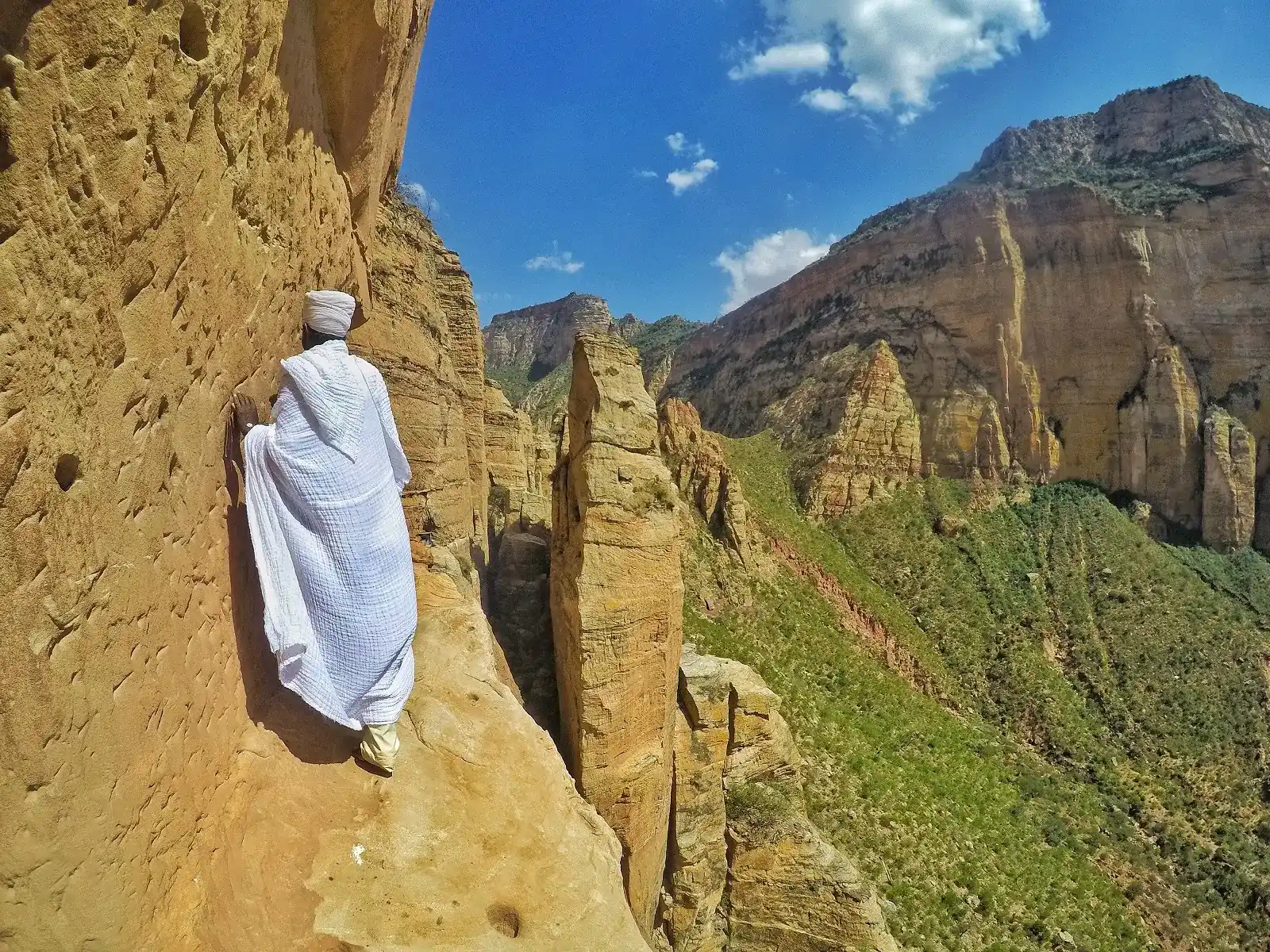
A crown-jewel of Ethiopia and a UNESCO World Heritage Site, Simien Mountains offers some of the world’s finest trek-routes, unique wildlife..
Learn More
Dating back to the previous millennium, the beautiful city of Harar is one of the oldest cities in Ethiopia. Located on the border of….
Learn More
The Omo Valley, often more precisely called the Lower Omo Valley, is a place like no other. Home to a number of tribal communities,….
Learn More
Free itinerary consultation – no obligation, typically a reply within 3 minutes.