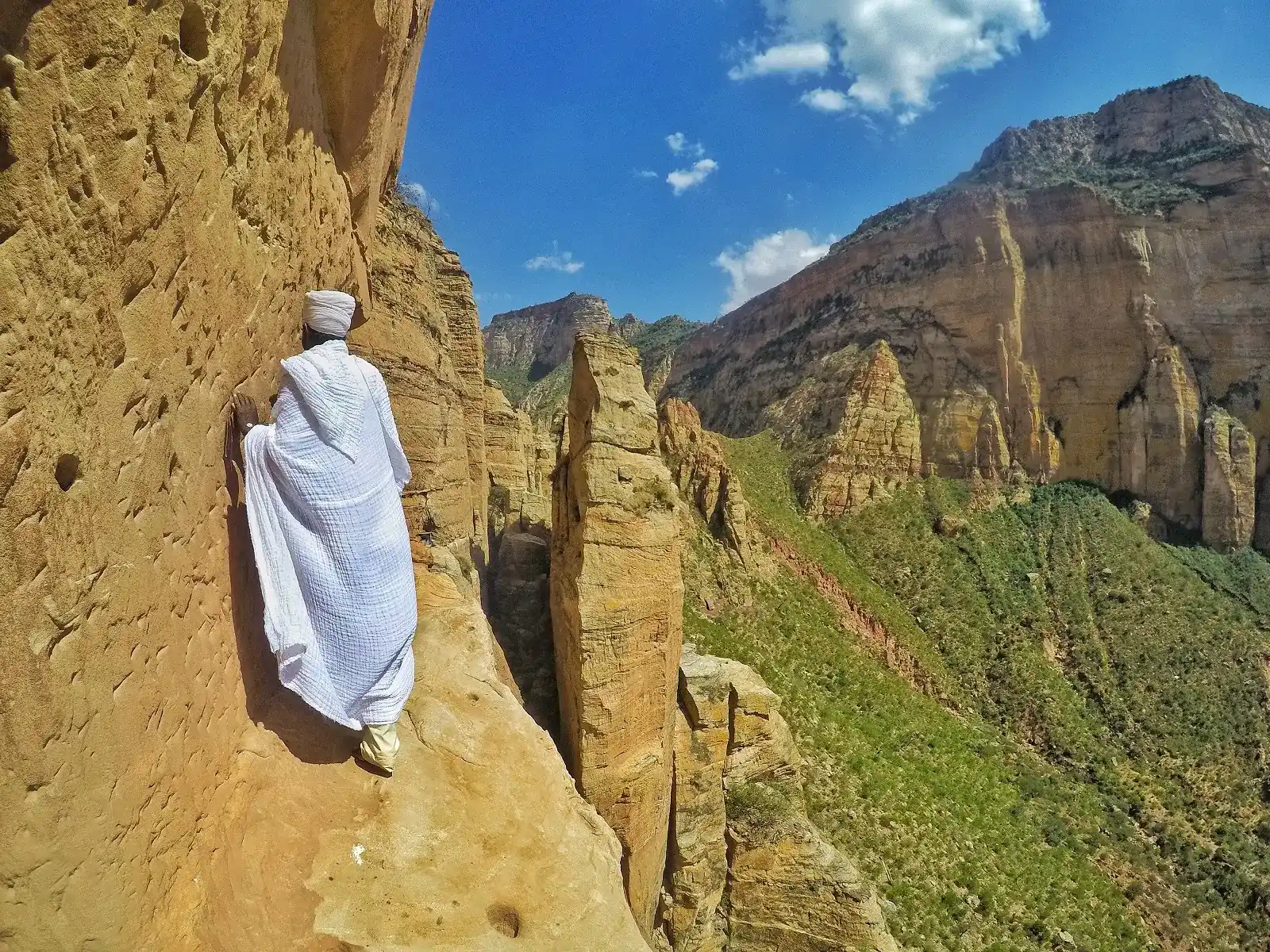
There’s a moment, about two-thirds of the way up a bare sandstone pillar in Ethiopia’s Tigray highlands, where the handholds run out and the only way forward is a narrow ledge with a long drop on either side. Then you pull yourself through a small opening in the rock, and you’re standing inside a church that’s been here since the 5th century, its ceiling covered in painted saints that have survived more than a thousand years of sun and wind. That’s Abuna Yemata Guh – and if you’re reading this, you’re probably trying to figure out whether to go, and how.
This guide covers the history, the climb itself, what it actually takes to get there, what it costs, and – because conditions in this part of Ethiopia can change – where to check the current situation before you book anything. If you’re weighing whether this belongs on your Ethiopia itinerary at all, this should give you enough to decide.
What Is Abuna Yemata Guh?
Abuna Yemata Guh is a monolithic rock-hewn church carved directly into a sandstone pillar in the Gheralta Mountains, in the Hawzen district of Ethiopia’s Tigray region. It’s one of more than a hundred rock-hewn churches scattered across northern Ethiopia, but it’s the one most people have heard of, largely because of how it’s reached: a scramble up a near-vertical cliff face, ending in a narrow ledge walk above a steep drop.
It remains an active place of worship. Local priests climb it regularly, and services are still held inside.
History & Religious Significance
The Nine Saints and the 5th-Century Origins
According to local tradition, the church was carved by Abuna Yemata, one of the Nine Saints credited with spreading Christianity through Ethiopia in the late 5th century. Choosing to build a church in such an inaccessible spot was, by most accounts, deliberate – a way of building a sanctuary closer to the heavens, set apart from the world below.
The Frescoes Inside
Once inside, the small chamber opens into a space decorated with paintings believed to date to around the 6th century. The region’s dry climate has helped preserve them remarkably well — the colors are still vivid, and the compositions are legible in a way that’s rare for artwork this old. The frescoes depict biblical figures and parables, painted onto domed ceilings that fill nearly every visible surface. It’s a big part of why this site, despite its size, draws serious attention from art historians as well as adventure travelers, and why the Ethiopian Orthodox Church continues to treat it as an active, working church rather than a museum piece.
Why Build a Church Here at All
It’s worth pausing on this, because it’s easy to treat the location as a gimmick. In the Ethiopian Orthodox tradition, remoteness and difficulty of access were often treated as spiritually meaningful rather than incidental – a church that demanded real effort and risk to reach was, in a sense, doing part of its job before a single service was held. Abuna Yemata Guh is the most famous example of that principle taken to its logical extreme, but it’s part of a broader pattern across the more than one hundred rock-hewn churches found throughout Tigray.
How Hard Is the Climb? An Honest Safety Breakdown
This is the section most visitors actually want answered, so we’ll be direct about it.
What the Ascent Actually Involves
The climb itself typically takes 30–45 minutes, depending on fitness and how many people are in your group, and breaks down roughly into three stages.
The first stretch is a walk across the base of the valley to reach the foot of the sandstone pillar – flat, easy, and a good chance to get a sense of scale before you start climbing. The second stage is where the actual scrambling begins: hand-and-foot climbing up sandstone using centuries-old footholds that have been worn smooth by generations of use. This section is steep and physical but has enough surface texture to feel manageable for most reasonably fit visitors. Partway up, there’s a spot where a local guide will usually offer a rope for extra security, more as reassurance than technical necessity.
The third and final stage is the one everyone talks about afterward: a narrow ledge, barely wide enough for one foot at a time, running along the cliff face with a drop of well over 100 meters on one side. It lasts only a couple of minutes, but it’s the part that requires real composure.
There’s no via ferrata, no railing, and no modern climbing gear involved in the traditional route. What you do get is a local guide who does this climb constantly and knows exactly where to place your hands and feet – which, for most visitors, matters more than any piece of equipment would.
Has Anyone Died Climbing It?
Despite its reputation as one of the world’s most dangerous churches, there’s no confirmed record of a visitor or worshipper dying during the climb. Local priests — some of whom have made this ascent nearly every day for decades, well into old age — point to this as evidence the route is, in their words, blessed. Whatever you make of that, the practical takeaway is this: with a competent guide, appropriate caution, and reasonable fitness, this is a climb that’s been done safely by an enormous number of people, including children and elderly worshippers from the local community.
That said, “no recorded deaths” isn’t the same as “no risk.” Loose rock, poor footwear, and rushing the final ledge are the real hazards, and they’re avoidable ones.
Who Should Consider Skipping the Climb
If you have a significant fear of heights, limited mobility, or any condition that affects balance, this isn’t the church to push yourself on. The good news is you don’t have to skip Tigray’s rock-hewn churches altogether – there are excellent alternatives nearby that don’t require the same exposure.
How to Get There
Addis Ababa to Mekelle or Axum
Most visitors fly into Addis Ababa first, then take a short domestic flight to Mekelle (around an hour) or Axum, both of which serve as gateways to the Gheralta area.
From Hawzen to the Trailhead
From Mekelle, it’s roughly a 1.5–2 hour drive to the Hawzen area, where the pillar and the small village of Guh sit at its base. Most tours arrange this transport as part of the package, along with a licensed local guide, which is effectively mandatory for the climb.
What to Bring and How to Prepare
- Footwear: Many local worshippers climb barefoot for grip and tradition, but grippy hiking shoes are the safer choice for visitors unfamiliar with the rock.
- Fitness: You don’t need to be an athlete, but comfort with scrambling and a reasonable tolerance for exposed heights matters more than raw strength.
- Water and sun protection: There’s no shade on the climb itself, and the surrounding valley gets hot.
- Modest dress: This is an active place of worship – cover shoulders and knees.
- Small cash: For the guide fee and, if offered, the rope-assist fee for the final stretch.
How Much Does It Cost?
Pricing varies by operator and whether you’re booking a standalone day trip or a multi-day trek that combines several Gheralta churches. As a rough market benchmark, full-package day tours from Mekelle – including guide, transport, and entry fees – tend to fall in a broadly similar range across established operators, with multi-day treks costing proportionally more given the added accommodation and logistics. Rather than quote a figure that will go stale, we keep an up-to-date breakdown on our pricing comparison page.
Budget separately for the small guide fee paid on-site for the rope assist during the final stretch – this is customary, not optional, and it directly supports the community that maintains the site.
Best Time of Year to Visit
The dry season, roughly October through May, is the best window. Rock surfaces get slick and considerably more hazardous during the rainy season (June–September), and this is one climb where surface grip really does matter.
What You’ll See Once You’re Inside
The chamber itself is small – this isn’t a cathedral, it’s an intimate, almost secretive space. The painted domes and walls are the highlight, along with carved details in the rock that have held up since the church was first hewn. Stepping back outside onto the ledge, the view across the Gheralta valley is, for most visitors, worth the climb on its own – a wide sweep of pinnacles and farmland stretching out well below you.
A couple of practical notes for photography: interior lighting is dim and flash photography isn’t appropriate given the site’s active religious use, so a camera that handles low light well (or simply patience with a phone camera) helps. The best exterior shots tend to come from the ledge just outside the church entrance, looking back down the valley in the mid-morning light before the sun gets too harsh overhead.
Combining It With Other Gheralta Cluster Churches
If you have more than a day in the area, Abuna Yemata Guh pairs naturally with other churches in the same cluster, several of which are far less physically demanding but share the same dramatic setting and similarly old frescoes. Spreading the visit across two or three days also means you’re not rushing straight from one climb to another, which makes for a more comfortable trip and gives you room to absorb each site rather than checking it off a list.
Full Gheralta cluster itinerary
Current Travel Advisory Status for Tigray
Conditions in Tigray have shifted more than once in recent years, and they can change again with little warning. Rather than repeat outdated information here, we maintain a page dedicated to current status – flight availability, government advisories, and whether tours are actively running – and update it regularly.
Read more about current Tigray travel advisory status.
We’d rather send you to accurate, current information than have you make a decision based on a static blog post.
Ready to climb the church in the sky?
Abuna Yemata Guh is one of those places that’s genuinely as remarkable as its reputation suggests – just make sure you’re going in with accurate, current information rather than internet hype.
If you’re planning your 2026 adventure, book the one day Gheralta churches tour or a three days Tigray trekking adventure with us.


